DINOSAUR SCIENCE · 4 MIN READ
How Did Long-Necked Dinosaurs Become So Large?
Explore the combination of necks, lightweight vertebrae, breathing anatomy, and feeding that allowed sauropods to reach extraordinary sizes.
By Dinosaur Sounds ·
The short answer
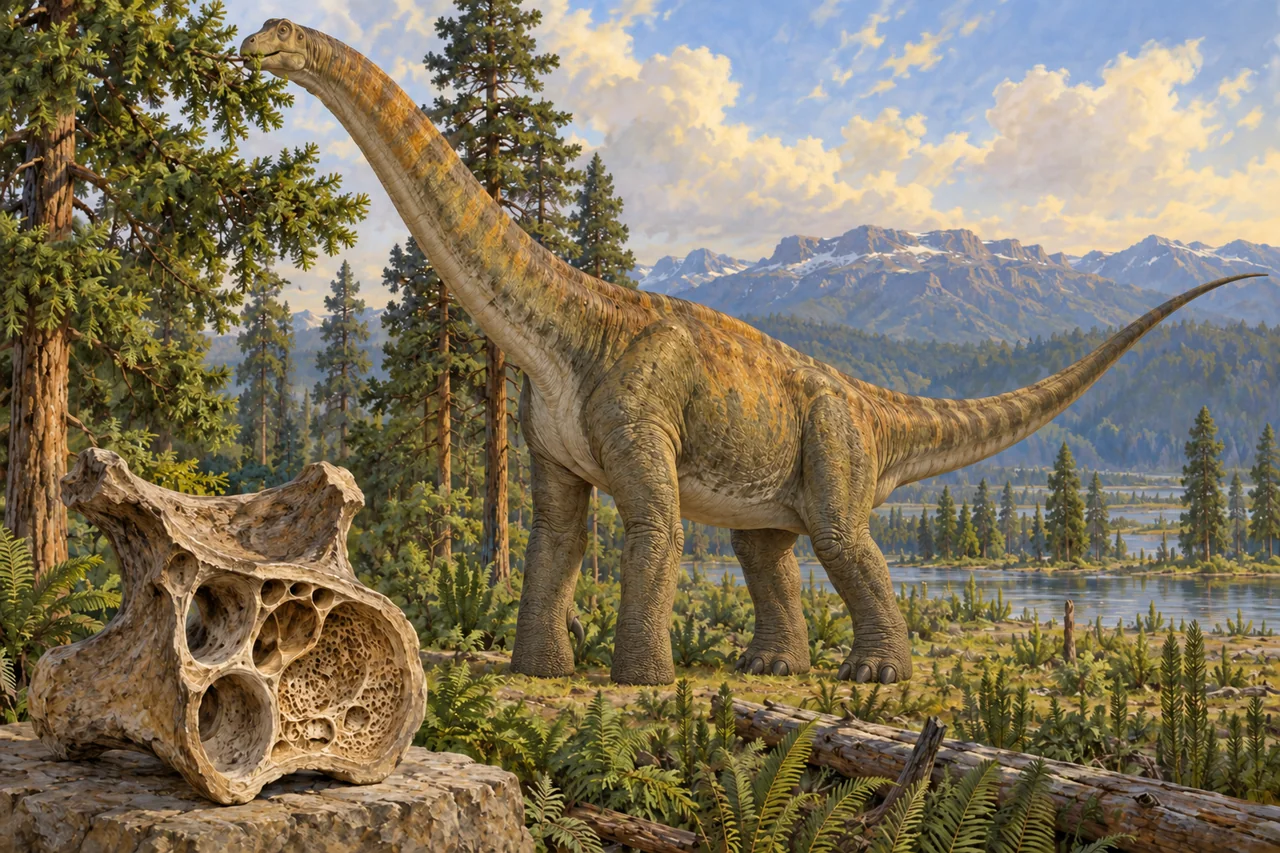
Sauropods became enormous through a combination of adaptations. Long necks, small heads, efficient food gathering, supportive limbs, and air-filled spaces in parts of the skeleton helped make giant bodies possible. No single feature explains their size on its own.
Not every dinosaur was huge, and even sauropods varied greatly. The important question is why this particular dinosaur group repeatedly evolved bodies beyond the size of most other land animals.
A long neck changes the feeding problem
A long neck can let an animal reach food over a large area without moving its heavy body at every mouthful. Some sauropods could also browse high vegetation.
Neck posture and feeding height differed between species and remain subjects of study. A low-reaching Diplodocus should not automatically be pictured feeding exactly like a high-shouldered Brachiosaurus.
A review of sauropod neck anatomy examines the combination of vertebrae, head size, and respiratory features associated with unusually long necks. The neck was part of an integrated body, rather than an isolated extension added to an ordinary animal.
Why a small head could help
Supporting a heavy head at the end of a long neck creates mechanical demands. Sauropod heads were relatively small compared with their bodies.
Their teeth generally gathered or cropped food instead of processing it with mammal-like chewing. That could reduce the need for large chewing muscles and a bulky skull.
It does not mean digestion was effortless. Plants still had to be broken down after swallowing, and different sauropods had different teeth and feeding strategies. A small head solved some problems while making the digestive system especially important.
Bones with internal air spaces
Many sauropod vertebrae contained substantial internal spaces connected with the respiratory system. This condition is called skeletal pneumaticity.
Air spaces could reduce mass while the surrounding bone retained structural support. A study of pneumaticity and dinosaur breathing discusses the evidence linking such structures to an air-sac system.
The phrase “hollow bones” can be misleading if it suggests every bone was an empty tube. Different bones and different regions of the skeleton had different construction. Nor were air sacs balloons that floated the animal above the ground.
Breathing, food, and body size
Bird-like respiratory features are inferred for sauropods from skeletal anatomy and comparison with living relatives. Efficient ventilation is one component of explanations for their success.
The Natural History Museum's guide to dinosaur gigantism brings together breathing, growth, and feeding considerations. Large digestive capacity and rapid growth also matter in the overall picture.
Researchers investigate how these traits interacted through evolution. A useful explanation must show how the entire animal could function: obtaining food, supporting weight, circulating blood, growing, and reproducing.
Giants still obeyed gravity
Sauropods were land animals. Their legs supported their weight, and their skeletons show adaptations for bearing large loads. They did not need to spend their lives floating in lakes simply because early illustrations imagined them that way.
A wide body and robust limbs also affect balance and movement. “Bigger” brings costs as well as opportunities, so large size cannot be understood as an automatic improvement.
Modern blue whales reach extraordinary masses with support from water. Comparing them with land dinosaurs requires recognizing that their environments impose different mechanical demands.
A useful comparison also states what was restored. A complete-looking drawing may hide missing vertebrae or uncertain body contours. Showing that information helps readers distinguish a well-constrained giant from a more tentative size proposal.
How sure are the size estimates?
Length can sometimes be reconstructed fairly well from a good skeleton. Body mass needs estimates of missing tissues, body volume, and density.
An incomplete giant fossil may support a broad size range rather than an exact record-breaking number. Different reconstructions can produce different results without either researcher being careless.
When reading a claim about the “biggest dinosaur,” ask whether it means longest, tallest, or heaviest, and how complete the evidence is.
Explore our Brachiosaurus guide, compare Stegosaurus, and visit the size comparison game. The interesting achievement is the functioning animal, not simply the largest number beside its name.
Sources
- Natural History Museum: Why were dinosaurs so big?
- Why sauropods had long necks
- Postcranial pneumaticity and the avian lung
Research reviewed: 7 October 2026.