DINOSAUR SCIENCE · 4 MIN READ
How Do Scientists Know How Old a Dinosaur Fossil Is?
Discover relative dating, volcanic ash, and radiometric clocks, and why carbon dating is unsuitable for dinosaur-age bones.
By Dinosaur Sounds ·
The short answer
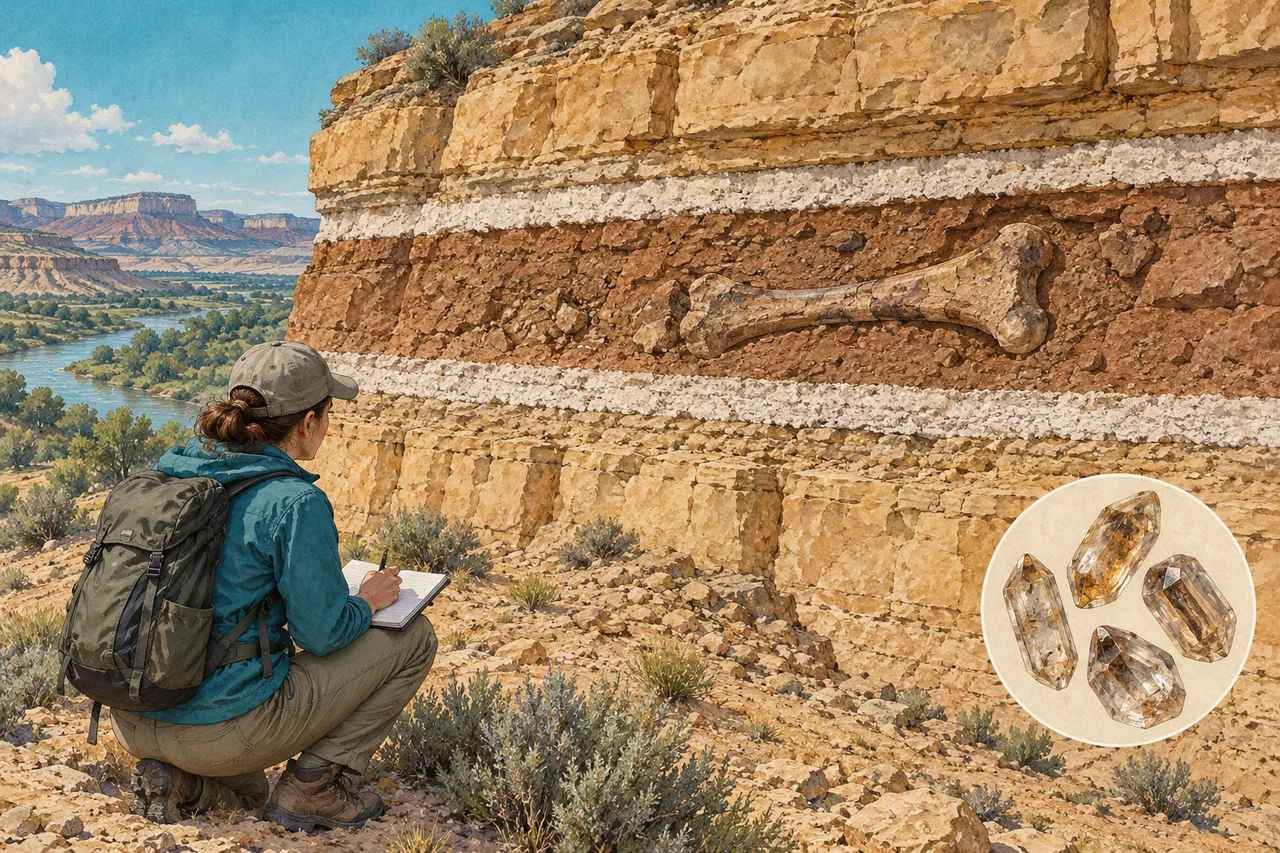
Scientists usually establish a dinosaur fossil's age by studying the rocks around it. They combine the order of rock layers with numerical dates from suitable minerals, often in volcanic ash. The result is a measured geological age with an uncertainty, rather than a birthday written inside the bone.
Two questions need separate answers: “Which fossil is older?” and “Approximately how many years old is it?” Different methods address those questions, then work together to build a timeline.
Reading the order of rock layers
Sediment often accumulates layer above layer. In an undisturbed sequence, lower layers were deposited before the layers above them. A fossil in a lower layer is therefore generally older than a fossil higher in the same sequence.
This is relative dating. As the National Park Service explains, it establishes older and younger relationships without automatically giving an age in years.
Real geology can be complicated. Rock layers may be folded, faulted, or overturned. A fossil can also be eroded from one deposit and carried into a younger one. Geologists inspect the whole setting before treating a simple “lower means older” rule as reliable.
Why volcanic ash is so helpful
Dinosaur bones are commonly found in sedimentary rocks. A volcanic eruption may spread ash across a landscape, leaving a layer that later becomes part of that sequence.
Some minerals in volcanic material contain radioactive elements whose decay can be measured. If suitable ash layers lie below and above a fossil-bearing bed, their dates can help bracket the time when that sediment accumulated.
The Park Service's account of volcanoes and fossils describes this connection. The dated material may be the ash, rather than the dinosaur bone. That difference matters when reading the phrase “a fossil was dated.”
Picture a photograph between two pages carrying reliable dates. The dates constrain when it was placed there, provided the pages remain in their original order. Geological bracketing uses a more complex version of that logic.
How a radiometric clock works
Radioactive parent isotopes change into daughter products at predictable rates. Scientists measure appropriate isotope ratios in a mineral and use the decay rate to estimate elapsed time.
The mineral must suit the method, and its geological history must be understood. Heating or chemical alteration can disturb a system. Researchers therefore use careful sample preparation, multiple measurements, and geological checks rather than accepting any single number.
Different methods work over different timescales. Carbon-14 is useful for much more recent once-living material. Its short half-life makes it unsuitable for measuring the tens of millions of years involved in non-bird dinosaurs. Dinosaur dating does not depend on finding usable carbon-14 inside a Mesozoic bone.
Matching one place to another
A rock sequence rarely preserves every interval continuously. Geologists compare locations using distinctive beds, changes in magnetic signals, and fossil assemblages.
Some fossils are particularly useful for correlating layers because the organisms were widespread and existed during a limited interval. Correlation connects sequences; it does not mean every similar-looking fossil has exactly the same age.
The National Park Service's timescale guide explains how relative and numerical approaches support one another. The strength comes from agreement between independent lines of evidence.
The age of a rock layer and the lifespan of its dinosaur are different measurements. A fossil can be 150 million years old without revealing whether the individual was ten or twenty when it died.
Why ages are written as ranges
A dinosaur species may be known from rocks deposited over a span of time. A particular specimen has its own narrower geological context. Neither should be confused with how long that individual animal lived.
“About 150 million years ago” is an approximate placement on Earth's timeline. A numerical date may also include a margin of uncertainty. A revised date can refine the timeline without making the entire fossil record unreliable.
To practice, compare our Jurassic overview with the Cretaceous overview. Stegosaurus and T. rex belong in different chapters. Asking both “where?” and “when?” is the quickest way to avoid building a dinosaur world that never actually existed.
Sources
- National Park Service: Volcanoes and fossils
- National Park Service: Geologic timescale and dating techniques
- National Park Service: National Fossil Day questions
Research reviewed: 7 October 2026.