DINOSAUR SCIENCE · 4 MIN READ
How Dinosaur Bones Become Fossils: A Journey Through Rock
Follow a dinosaur bone from burial to discovery, and learn why the fossil record preserves only a small part of ancient life.
By Dinosaur Sounds ·
The short answer
Most dinosaur bones disappeared after death. The rare ones that became fossils usually survived burial, chemical change, and millions of years inside rock. Some preserve mineralized bone; others survive as impressions or natural casts. A fossil is evidence of ancient life, rather than simply any unusually shaped stone.
Imagine following one bone through that journey. At every stage, something could destroy it. Understanding those risks helps explain both the discoveries in museums and the enormous gaps that remain in dinosaur history.
First, a bone has to survive
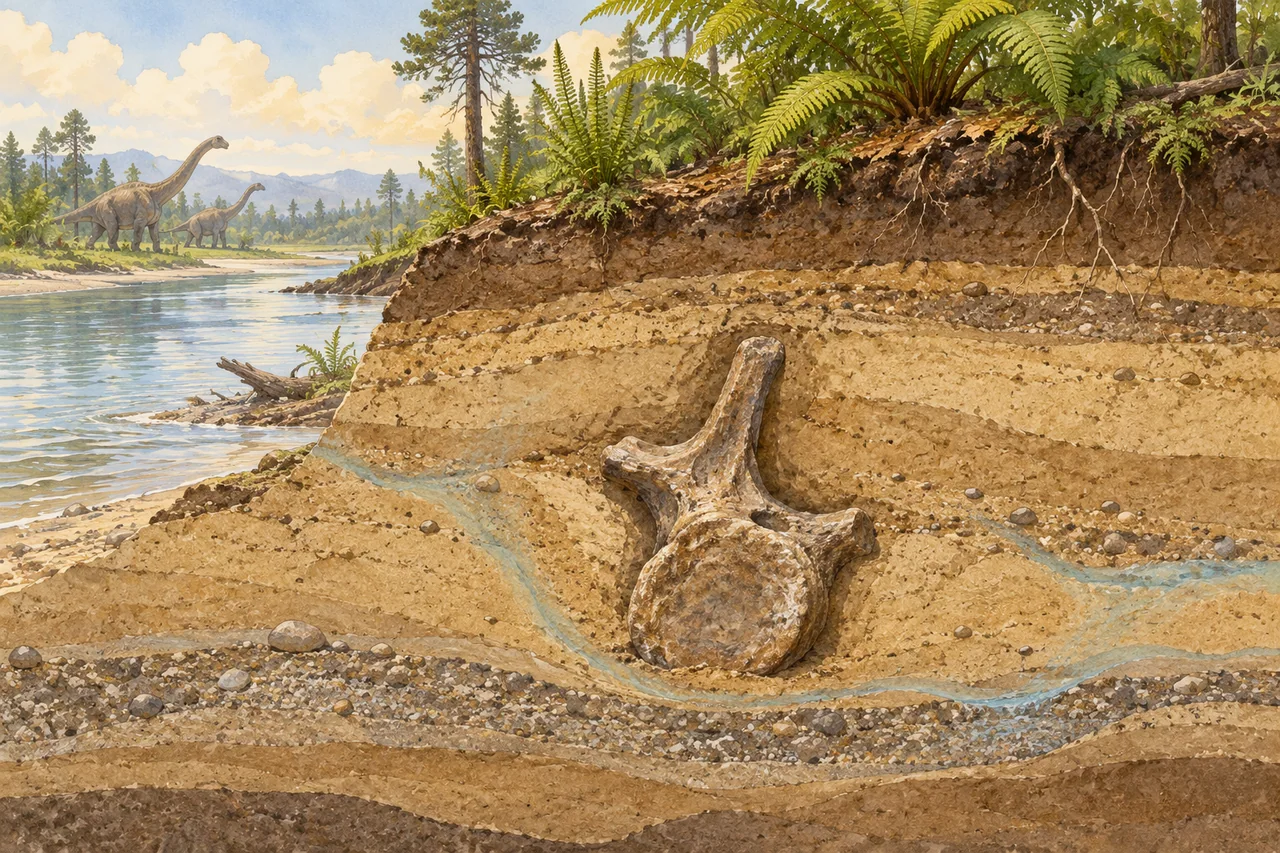
After an animal dies, scavengers may scatter its skeleton. Weather, flowing water, and microbes can damage what remains. Burial in mud, sand, or other sediment can protect a bone before it is completely broken down.
The Natural History Museum's fossil formation guide explains why river and lake environments are especially useful for preserving land animals. Floods can cover remains with sediment. This does not mean every dinosaur died in a flood, or that every fossil followed one identical route.
A useful distinction is between where an animal lived, where it died, and where its remains were finally buried. A river might carry bones away from the original habitat. Scientists therefore investigate surrounding rocks as carefully as the bones themselves.
What happens inside the ground?
Groundwater can carry dissolved minerals into the tiny spaces within a bone. Those minerals may crystallize there, preserving details of its internal structure. Original materials can also change or be replaced during the long history of burial.
The word “petrified” describes something turned to stone, but it should not suggest that a skeleton instantly becomes a solid stone model. Fossilization involves different physical and chemical processes, and different specimens retain different amounts of original material.
As more sediment accumulates, pressure and cementation can turn it into sedimentary rock. The fossil and its surrounding rock then share a long geological history. They might be heated, cracked, tilted, or deeply buried. A beautifully preserved bone is a survivor of all those changes.
Bones are only one kind of fossil
A dinosaur footprint can become a fossil without the dinosaur dying there. An impression left in suitable sediment may be covered and preserved. The same broad category includes feeding marks and fossil dung.
The National Park Service distinguishes body fossils from trace fossils. Body fossils help reveal anatomy. Trace fossils often show activities. A tooth and a footprint answer different questions, even when both come from the same rock formation.
Sometimes a shell or bone dissolves and leaves a natural mould. Material filling that space can make a cast. That geological cast is different from a museum replica made by people, although both preserve a shape.
Why does a fossil appear at the surface?
A fossil may remain hidden until uplift and erosion expose its rock layer. Rain, rivers, wind, and frost gradually remove surrounding material. Discovery happens during a short interval: after enough rock has vanished to reveal the fossil, but before the fossil itself is destroyed.
That is why a fossil can be both ancient and newly exposed. Its appearance on a hillside today does not mean the animal died recently.
The Museum's overview of fossil evidence also shows why researchers value small remains, impressions, and microscopic fossils alongside spectacular skeletons. Each contributes a different part of the ancient scene.
What the missing fossils tell us
The fossil record is a sample with uneven coverage. Hard parts generally survive better than delicate tissues, and some environments preserve remains more readily than others. An animal absent from one fossil site was not necessarily absent from the wider region.
Try this thought experiment: imagine describing an entire school from items left in one muddy playground corner. You could learn something real, but you would need to recognize what that corner failed to record. Paleontologists face a much larger version of that problem.
Compare the skeletons behind our Stegosaurus guide and T. rex guide, then explore the articles hub. Every confident reconstruction begins with evidence that survived an extraordinary journey.
Sources
- Natural History Museum: How are dinosaur fossils formed?
- National Park Service: What is a fossil?
- Natural History Museum: What is a fossil?
Research reviewed: 7 October 2026.