DINOSAUR SCIENCE · 4 MIN READ
How Fast Could Dinosaurs Move? Why Speed Estimates Differ
Understand dinosaur trackway estimates, walking models, and the mechanical limits that make exact top-speed rankings uncertain.
By Dinosaur Sounds ·
The short answer
Scientists estimate dinosaur speed using trackways, anatomy, and biomechanical models. Different methods answer different questions and depend on different assumptions. A trackway might record a leisurely walk, while a computer model investigates the fastest movement a body could plausibly sustain.
There is no complete, reliable dinosaur racing table. Exact rankings become especially uncertain when species are known from incomplete skeletons or lack suitable trackways.
What track spacing can tell us
A trackway preserves successive foot placements. Researchers measure stride length and estimate the animal's hip height, often using the dimensions of the prints.
Mathematical relationships can then provide an approximate speed. The Colorado Geological Survey's trackway resource demonstrates the reasoning behind this kind of investigation.
The estimate depends on assumptions about body proportions and gait. Soft ground can alter print shape, and an animal may change speed within the preserved sequence. Measurements need to be interpreted with that context.
A walking trackway is not a maximum
Imagine measuring the speed of someone strolling to a library. The measurement could be accurate, but it would not reveal their best sprint.
The same distinction applies to dinosaurs. A trackway records an event. Even if the maker can be identified confidently, it usually does not reveal the limit of that animal's performance.
This prevents an important headline mistake: a low walking estimate does not by itself mean a dinosaur could never move faster. Conversely, a long stride is not proof of a record-breaking sprint without the rest of the analysis.
Building a moving dinosaur
Biomechanical models use a reconstructed skeleton, estimated muscles, joint movement, and body mass. Researchers can simulate movement and test what forces it requires.
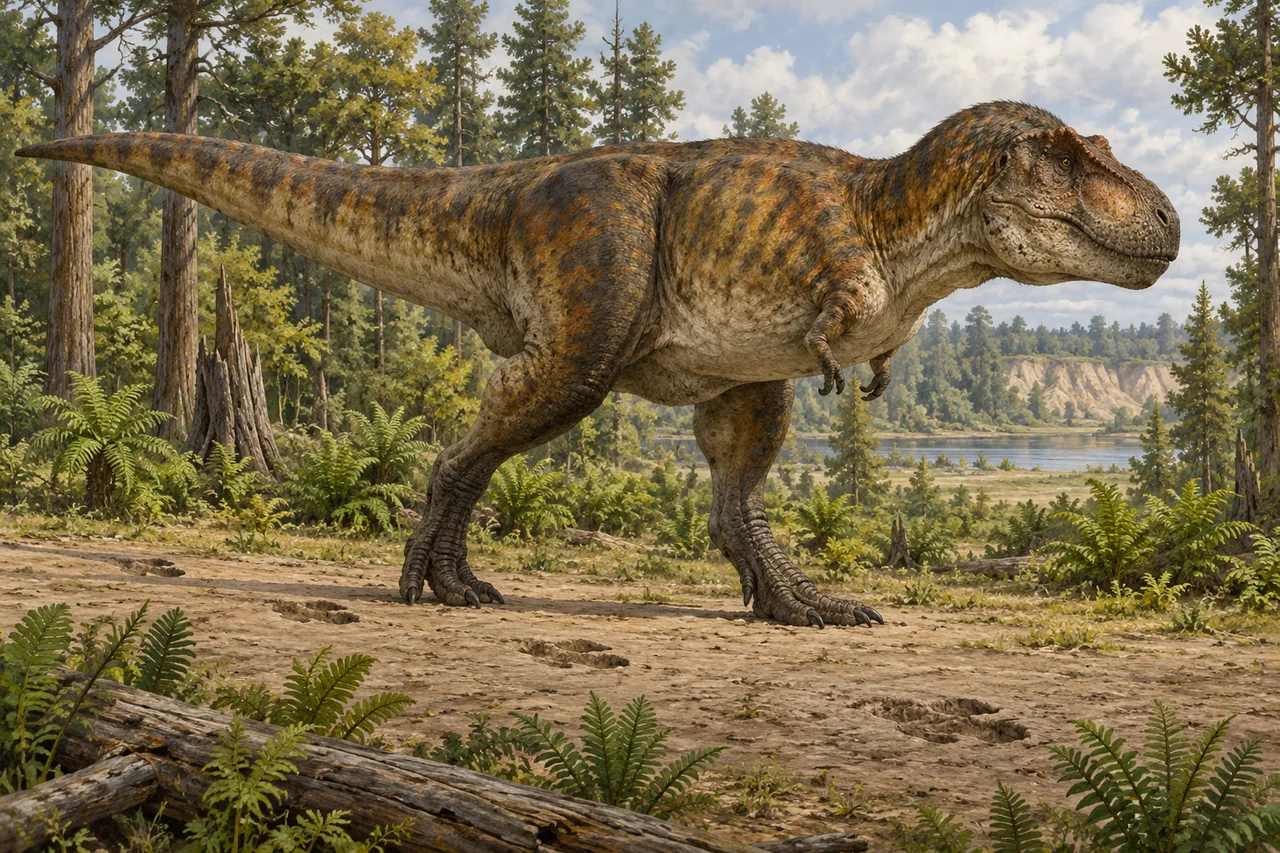
A study of T. rex running incorporated limits related to skeletal stress. The work illustrates why a model should consider what bones can withstand, rather than asking only whether powerful muscles could move the animal quickly.
The conclusion applies to the model and its assumptions. Different body reconstructions or muscle estimates can change the result, which is why researchers examine sensitivity rather than presenting a simulation as a direct observation.
The tail also affects walking
A dinosaur's tail was part of its moving body, not simply an accessory behind the legs. Muscles, ligaments, mass, and motion can influence locomotion.
A T. rex walking study used the tail's natural frequency to investigate preferred walking speed. That is a question about comfortable or economical movement, rather than the animal's highest possible speed.
The model required assumptions about soft tissues and tail properties. Its value lies in making those assumptions testable and showing another way anatomy can inform movement.
Large bodies face different demands
As animals become heavier, supporting weight and managing limb forces become increasingly important. Long legs can help cover ground, but they do not automatically guarantee high speed.
Balance, turning, acceleration, and endurance are also separate performance traits. An animal that was relatively economical over long distances need not have been the fastest sprinter.
Young and adult dinosaurs could differ in proportions and mass. A speed proposed for a large adult should not automatically be assigned to every growth stage.
Check the units as well. Kilometers per hour and miles per hour can turn the same estimate into very different-looking numbers. A responsible comparison uses matching units and distinguishes a calculated range from a simplified illustration.
How to read a speed claim
Look for three details: what was measured, which animal or specimen was used, and whether the value represents walking, running, or a theoretical maximum.
A useful report gives a range or explains uncertainty. A claim with many precise digits can still rest on rough estimates of missing tissues.
For a simple activity, measure your own stride during a slow walk and a brisk walk on safe, level ground. Notice that step length alone does not record every aspect of movement.
Compare our T. rex guide, Velociraptor guide, and dinosaur size game. Dinosaur movement is a mechanical puzzle whose best answers explain the evidence behind the number.
Sources
- T. rex running with skeletal stress constraints
- T. rex preferred walking-speed model
- Colorado Geological Survey: Trackway speed investigation
Research reviewed: 7 October 2026.