DINOSAUR SCIENCE · 4 MIN READ
From Hatchling to Giant: How Scientists Study Dinosaur Growth
Discover how bone growth marks reveal dinosaur life histories, why young animals look different, and where age estimates remain uncertain.
By Dinosaur Sounds ·
The short answer
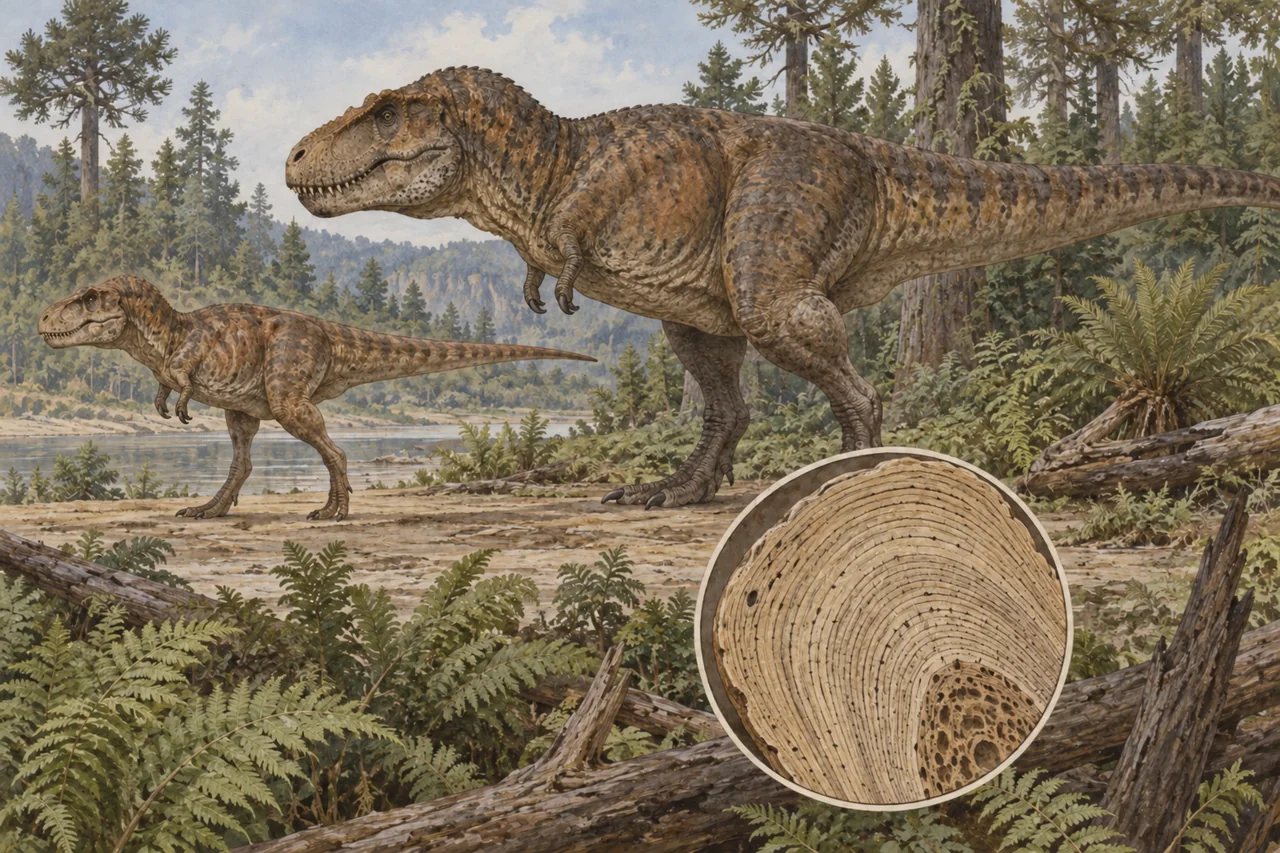
Scientists study dinosaur growth by comparing skeletons of different sizes and examining the microscopic structure of their bones. Growth marks can help estimate an individual's age and show when growth slowed. These methods reveal life histories, although incomplete fossils and altered bone can make the results uncertain.
An adult dinosaur was once a much smaller animal. Understanding that journey is essential because a youngster can differ from an adult in more than size.
A record hidden inside bone
Bone is living tissue during an animal's life. It grows, changes, and repairs itself. Under a microscope, a thin slice of fossil bone can preserve patterns linked to that growth.
The American Museum of Natural History describes readable growth marks as an important tool for dinosaur researchers. The comparison with tree rings is helpful, provided it is not pushed too far: bone has its own biology.
Researchers look at the spacing of growth marks, the organization of tissue, and signs that growth was approaching its end. A useful age assessment considers several features together rather than simply counting every visible line.
Why counting marks is complicated
As a bone enlarges, its inner region may be remodeled or resorbed. Earlier marks can disappear. Damage, incomplete preservation, and the choice of bone also affect how much of an individual's history survives.
Scientists may compare multiple bones, other individuals, and growth models to estimate missing information. Different assumptions can produce different age or growth estimates. Those uncertainties should accompany the result.
Imagine recovering only the last few pages of a height chart. The remaining measurements still tell you something, but they cannot directly show every earlier year. Fossil bone presents a more technical version of that challenge.
Building a growth curve
A single skeleton shows one individual at one point in life. A growth curve requires comparisons across individuals, ideally with both body-size and age information.
The Museum's explanation of T. rex growth discusses how bone evidence can reveal rapid growth and later slowing. Such reconstructions help investigate how a giant predator reached adult size.
An estimate for one species should not be applied to every dinosaur. Small theropods, horned dinosaurs, and giant sauropods evolved different bodies and probably had different life histories. Even individuals within a species could vary with health and conditions.
A youngster is not a miniature adult
During growth, skull shape, limb proportions, and display structures can change. A juvenile may have a relatively different head or longer-looking legs. That matters when identifying isolated fossils.
Two differently shaped skeletons might represent different species, different ages, or some other source of variation. Researchers test those possibilities using detailed anatomy and bone maturity. Size alone is insufficient.
This is one reason debates over dinosaur identification can last for years. New specimens may reveal a growth stage that was previously missing. Revising an interpretation is part of making the explanation fit a larger body of evidence.
What growth tells us about daily life
Body size influences food requirements, movement, and vulnerability. A growing carnivore might encounter different prey opportunities from a large adult. That possibility is an ecological inference that needs dietary and anatomical evidence alongside growth data.
Likewise, rapid growth does not by itself prove a precise body temperature. Researchers combine bone structure with other approaches when investigating dinosaur physiology.
The Natural History Museum's guide to reconstructing dinosaur lives shows how several methods complement one another. No single thin section tells the entire story.
Researchers must also check that a comparison really includes the same species. Mixing several similar species into one supposed growth series could produce a convincing-looking curve that describes no animal's actual development.
Questions to take to a museum
Look for whether a label identifies a juvenile, an adult, or an individual of uncertain maturity. Ask how that assessment was made. A smaller skeleton is not automatically a baby.
Then compare our T. rex guide and Triceratops guide, or explore the dinosaur profiles. Thinking about growth turns a static skeleton into evidence of an animal that changed throughout its life.
Sources
- American Museum of Natural History: The young and the fast
- American Museum of Natural History: How did T. rex get so big?
- Natural History Museum: What fossils reveal about dinosaurs
Research reviewed: 7 October 2026.