DINOSAUR SCIENCE · 4 MIN READ
How Dinosaurs Replaced Their Teeth: A Mouth Built for Renewal
Learn why many dinosaurs grew replacement teeth, how scientists measure replacement rates, and why shed teeth are valuable fossils.
By Dinosaur Sounds ·
The short answer
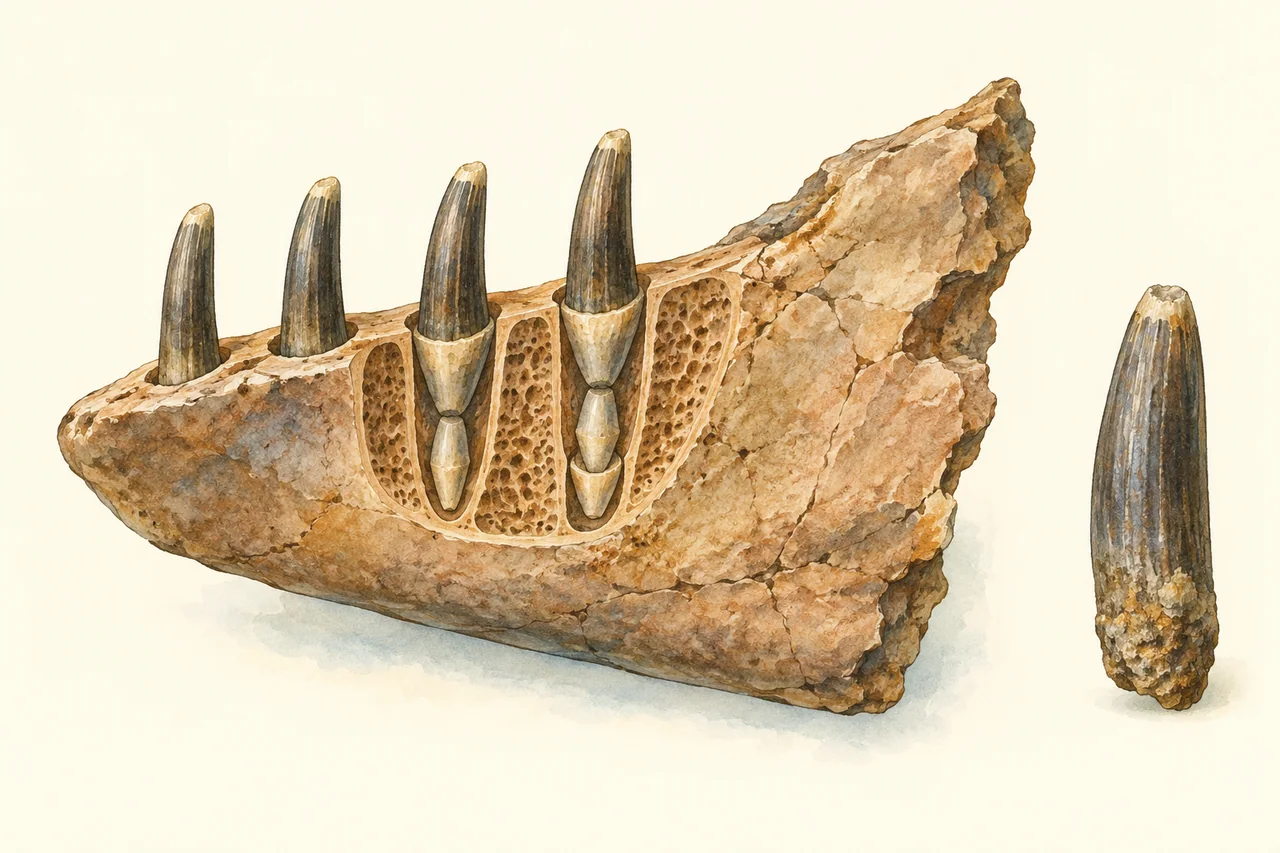
Many dinosaurs continually grew replacement teeth during their lives. As a working tooth wore down or was shed, another could develop into its place. The pattern and rate differed among dinosaur groups, and scientists can investigate that renewal inside fossil jaws.
A dinosaur losing a tooth was therefore not always suffering a disaster. In many species, tooth replacement was an ordinary part of keeping the mouth functional.
Replacement happened at particular positions
Think of a jaw as a series of tooth positions. Beneath or beside a working tooth, developing replacements could form a sequence.
Scientists sometimes call one such position and its successors a tooth family. This helps distinguish replacement at one location from what happened across the whole mouth.
That distinction matters when reading rates. “One tooth every several weeks” may describe a particular position, rather than a dinosaur dropping and regrowing its entire set at once.
Why plant eaters needed reliable tools
Feeding subjects teeth to wear. Repeated contact with plants, grit, and other material can damage the working surfaces over time.
Sauropods used teeth to gather vegetation, while other herbivores developed more elaborate arrangements for processing it. Their renewal systems helped maintain those different tools.
A study of sauropod replacement rates compared Camarasaurus and Diplodocus, two dinosaurs known from the same broad Late Jurassic ecosystem but with different teeth. Their estimated replacement schedules were not identical.
How can researchers measure growth?
Teeth can preserve microscopic lines associated with daily formation. Researchers examine tooth sections and compare developing teeth within a jaw to estimate formation and replacement times.
The sauropod study estimated average replacement intervals of about 62 days in a Camarasaurus tooth family and about 35 days in a Diplodocus tooth family. Those are study-based estimates for the sampled animals and methods.
They should not become universal countdowns for every tooth in every individual. Preservation, sample size, and biological variation affect how broadly a result can be applied.
A narrow tooth and a broad tooth
Diplodocus had relatively narrow teeth, whereas Camarasaurus had broader crowns. Tooth size, enamel, formation time, and feeding demands all influence the cost of maintaining a dentition.
A study of sauropod skull and tooth evolution investigates how these differences relate to replacement and wear. Fast renewal is one way to keep functioning teeth available, but it is not the only variable.
A larger tooth takes more material to build. A narrow tooth may be replaced quickly. Comparing both quantity and construction gives a better picture than simply awarding one dinosaur the fastest mouth.
Dental batteries used a different arrangement
Hadrosaurs had tightly organized dental batteries, with replacement teeth helping maintain food-processing surfaces. The jaw acted as an integrated system.
The Natural History Museum's Parasaurolophus profile describes its numerous teeth and reserve replacements. Not every tooth was a separate exposed point working at the same moment.
A complex battery should not be drawn as a human smile with hundreds of identical visible teeth. Fossil jaw anatomy shows how the teeth were actually packed and used.
A shed crown and a complete rooted tooth also preserve different information. The part that survives affects what researchers can measure, so a collection of isolated crowns cannot answer every question that a jaw with developing replacements can.
Why loose teeth are useful fossils
Shed teeth can survive even when a complete skeleton does not. Their shape, wear, and location can provide clues to animals and environments.
An isolated tooth is also a limited clue. Similar teeth can belong to related species, and water may move a tooth away from where it was shed. A precise identification needs appropriate supporting evidence.
For a family comparison, sketch one narrow cropping tooth and one broad processing tooth, then ask what each could do and how wear might change it.
Explore our Brachiosaurus guide, compare Triceratops teeth, and try the diet sorting game. A dinosaur mouth was a changing system, continually maintaining the tools needed for its next meal.
Sources
- Evolution of high tooth replacement rates in sauropods
- Sauropod dentition and skull evolution
- Natural History Museum: Parasaurolophus teeth
Research reviewed: 7 October 2026.