DINOSAUR SCIENCE · 4 MIN READ
Why Did Some Birds Survive the Dinosaur Extinction?
Explore the survival hypotheses involving small bodies, seeds, and ground habitats, and why flight alone cannot explain the survivors.
By Dinosaur Sounds ·
The short answer
Some bird lineages survived the end-Cretaceous mass extinction, while non-bird dinosaurs and many ancient birds disappeared. Researchers investigate a combination of small body size, feeding opportunities, and habitat. Seed eating and life on the ground are influential hypotheses, rather than a complete proven explanation for every survivor.
The key question is not why all birds survived. They did not. It is why particular branches persisted through an enormous ecological crisis.
Birds already existed before the impact
Bird evolution began long before the asteroid struck about 66 million years ago. The Cretaceous world contained several kinds of birds and close bird relatives with different anatomy and lifestyles.
The Natural History Museum's guide to survival places modern birds within theropod dinosaurs. They were not a new group that appeared after the disappearance of T. rex.
This ancestry makes the extinction story more precise: the non-bird branches vanished, while a limited set of bird lineages continued.
Surviving the aftermath mattered
The impact's consequences extended beyond the immediate blast. Reduced sunlight and disrupted plant growth could affect food webs far from the crater.
An animal's survival depended on finding sufficient food and reproducing through changing conditions. A trait useful in an ordinary forest might become a disadvantage after that forest was damaged.
This is why researchers look at ecology alongside anatomy. Wings, beaks, and small bodies matter through the opportunities and constraints they created in a particular environment.
The seed-eating hypothesis
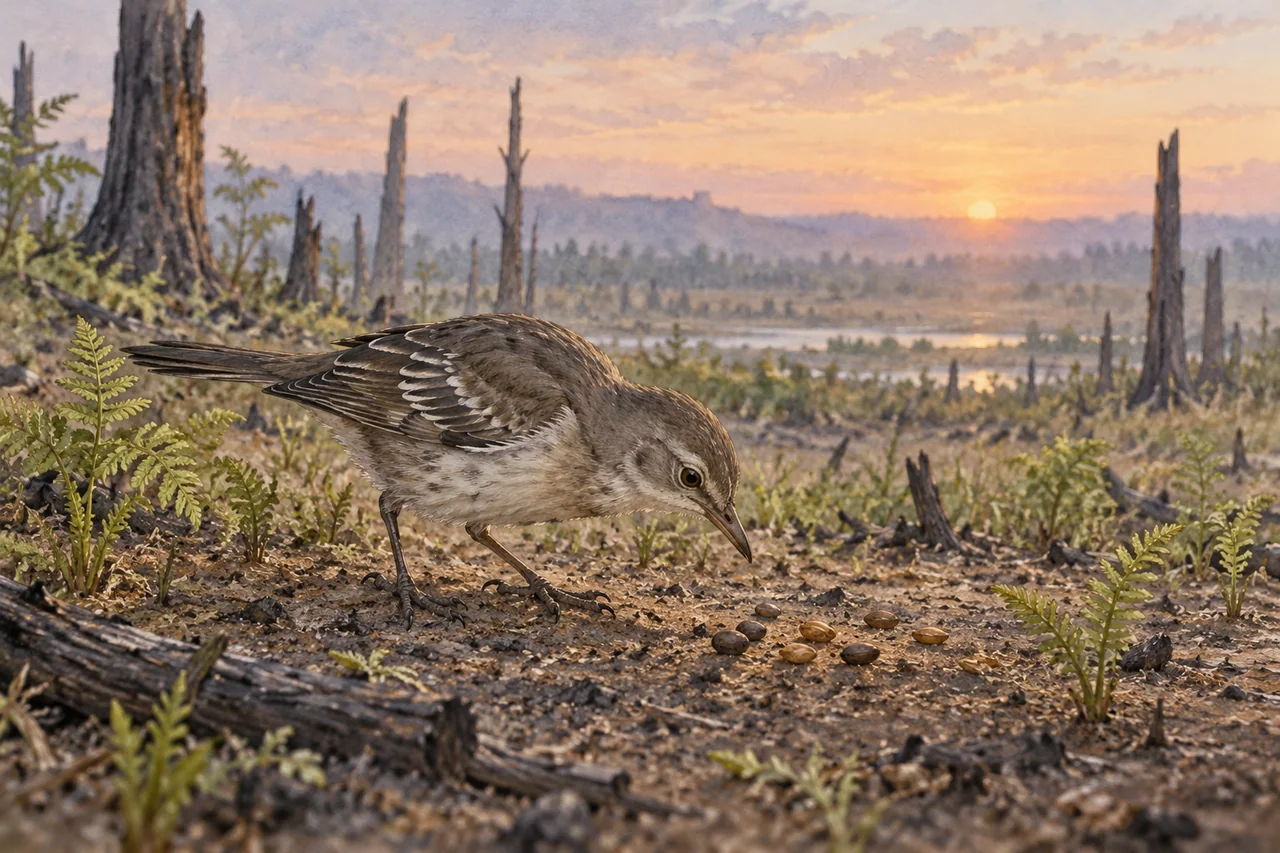
Seeds can provide stored food even when living vegetation is severely affected. Some researchers have proposed that toothless, seed-eating bird ancestors were better positioned to find food during the crisis.
A study of dental diversity in bird-like dinosaurs investigated feeding ecology leading up to the extinction. It contributed to the argument that dietary differences may help explain survival patterns.
This does not mean every surviving bird ate only seeds. The hypothesis addresses an ecological advantage that may have mattered in some lineages, with continuing uncertainty about exact ancestral diets.
The ground-habitat hypothesis
Another proposal concerns the collapse of forests. Birds strongly dependent on trees could have lost crucial nesting and feeding habitats.
Research summarized by the University of Bath combined plant evidence with the ecology of bird lineages to investigate this possibility. It proposed that surviving ancestors were associated with ground habitats, with tree-dwelling lifestyles evolving again afterward.
The reconstruction is inferred from several datasets. It is not a direct fossil record of every bird's behavior on the day of the impact.
Why flight cannot explain everything
Flight can help an animal move between places, but it cannot guarantee food, nesting sites, or survival through prolonged ecological disruption.
Many ancient birds disappeared despite being able to fly. Pterosaurs also vanished at the end of the Cretaceous. A simple “they flew away” explanation therefore fails to account for the pattern.
Researchers seek combinations of traits and circumstances that distinguish survivors from victims. Even then, chance and regional conditions may have influenced which populations persisted.
What scientists still need to discover
The fossil record around the extinction is incomplete, especially for small animals with delicate skeletons. New specimens can improve estimates of which lineages were present and how they lived.
Scientists also compare evolutionary trees, body sizes, diets, and environments. Each approach has assumptions that need to be checked against the others.
A confident answer about the asteroid's role can coexist with uncertainty about the detailed survival mechanisms of particular birds. Those are different levels of the same historical problem.
A useful way to imagine survival
Choose a hypothetical small bird and list what it needs: food, shelter, suitable climate, and opportunities to reproduce. Then consider which needs become harder when forests and food webs change.
That exercise turns a dramatic event into an ecological question. It also avoids inventing a single heroic ancestor for all living birds.
Read our asteroid article, explore the Cretaceous Period, and compare dinosaur sounds. Today's birds connect us to both an ancient extinction and an extraordinary survival story.
Sources
- Natural History Museum: Why birds survived
- University of Bath: Forest loss and bird survival
- Dental disparity and bird-like dinosaur ecology
Research reviewed: 7 October 2026.