DINOSAUR SCIENCE · 4 MIN READ
Were Pterosaurs Dinosaurs? A Guide to the Flying Reptiles
Learn why pterosaurs were close dinosaur relatives, how their wings worked, and why Pterodactylus is only one part of their story.
By Dinosaur Sounds ·
The short answer
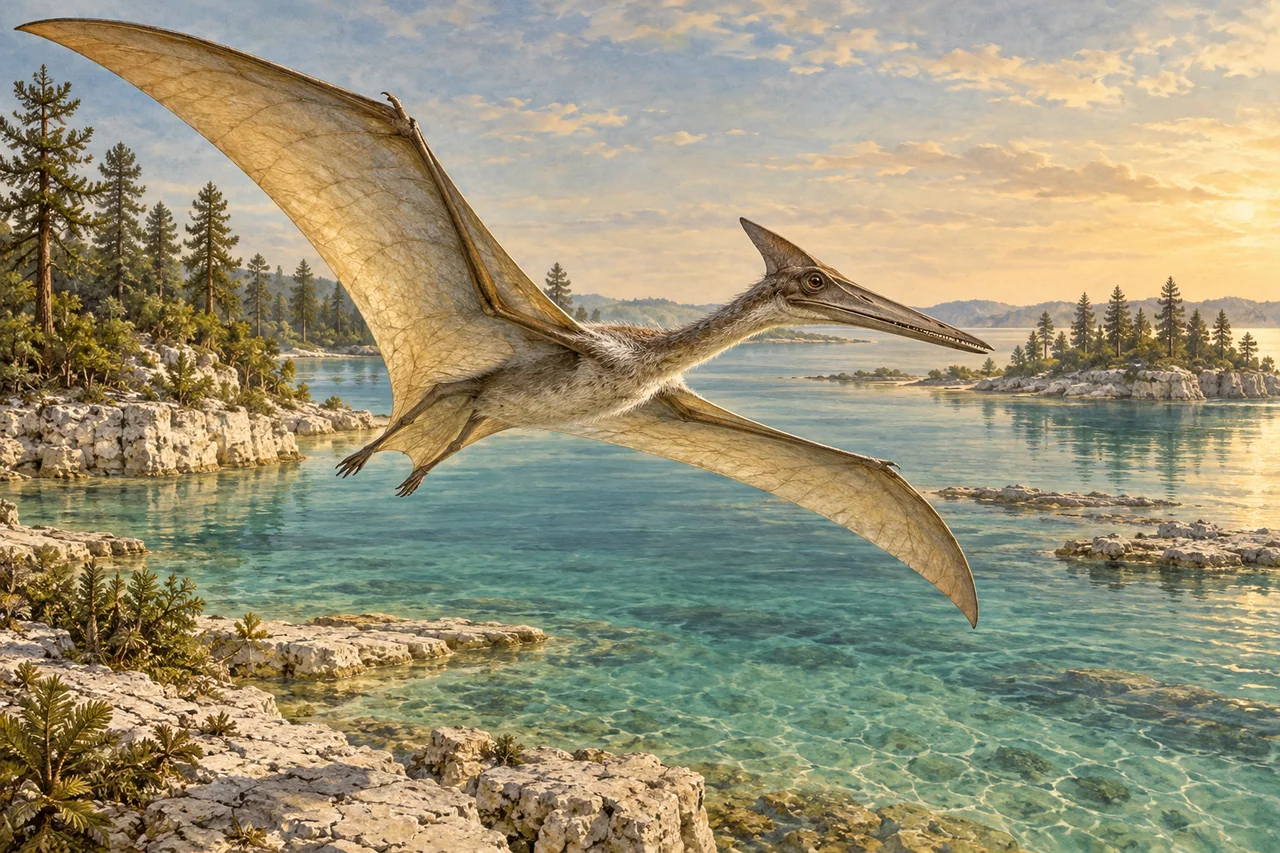
Pterosaurs were flying reptiles closely related to dinosaurs, but they belonged to a separate branch of the reptile family tree. Their wings used membranes supported largely by an extremely long fourth finger. Birds, which are dinosaurs, evolved a different kind of wing.
Sharing a prehistoric landscape does not make two animals members of the same group. A pterosaur flying above a dinosaur was a neighbor and relative, rather than a dinosaur with unusual arms.
A branch beside the dinosaurs
Dinosaurs, pterosaurs, and crocodilians belong within the broader archosaur family. Pterosaurs are closer relatives of dinosaurs than crocodilians are, but the pterosaur lineage remains distinct.
The American Museum of Natural History explains their relationship through anatomy and evolutionary history. Classification depends on ancestry rather than whether an animal flew, swam, or lived a very long time ago.
That is why “flying reptile” can describe a pterosaur while “flying dinosaur” correctly describes a bird. The habitat is a clue to lifestyle; the family tree determines the group.
The finger inside the wing
A pterosaur wing was not simply a bird wing without feathers. Its membrane extended along the arm and a greatly elongated fourth finger. The remaining fingers formed a smaller clawed portion of the hand.
Bird wings have a different arrangement of bones and rely on large flight feathers to form much of the lifting surface. Bat wings use membranes stretched across several elongated fingers, creating another solution to powered flight.
These comparisons are useful because all three wings are modified forelimbs, yet their detailed construction differs. Similar functions can evolve along different branches.
The first flying vertebrates
Pterosaurs were the first vertebrates known to evolve powered flight. Insects had flown earlier, so they were not the first flying animals of every kind.
The Museum's pterosaur exhibit overview also highlights their enormous range in size. Some were small, while the largest known forms were among the biggest flying animals.
A large wingspan does not mean a pterosaur had the same body mass or lifestyle as a large dinosaur. Wings, lightweight construction, and specialized anatomy change how an animal meets the demands of movement.
Was every pterosaur a pterodactyl?
Pterodactylus is a particular genus of pterosaur. “Pterodactyl” is commonly used informally for the whole group, but it can hide how varied pterosaurs were.
Different species had different skulls, teeth, tails, and wing proportions. Some early forms had long tails, while many later forms had short tails. Some skulls carried striking crests. There was no single universal pterosaur shape.
The Museum's explanation of why Pterodactyl is not a dinosaur is a useful starting point for sorting the familiar names.
How do scientists reconstruct flight?
Fossil bones show joints, proportions, and muscle attachment areas. Exceptional specimens can preserve traces of wing membranes and body coverings. Researchers also use mechanical models to test what particular reconstructions could do.
A reconstruction still requires choices where tissue is missing or distorted. An attractive picture of a flying pterosaur should therefore be understood as a scientific interpretation, rather than a direct view of the past.
Exact colors and many everyday behaviors remain uncertain. Nor should every pterosaur be drawn catching fish: the group included animals with different feeding adaptations.
Add geological age to your cards as well. Two correctly classified animals can still make an inaccurate scene if they lived at different times. A family relationship describes ancestry; it does not establish that any particular pair of relatives coexisted.
An easy sorting activity
Choose three animals: a modern bird, a pterosaur, and a non-bird dinosaur. Ask first about their family relationships, then about their wings and habitats.
This prevents a common shortcut in which land, sea, and sky become separate “types of dinosaur.” Real evolutionary groups are more interesting because relatives can occupy different environments.
Continue with our Velociraptor facts, compare the Mosasaurus article, and visit the articles hub. Sorting the relatives correctly makes a prehistoric scene more accurate.
Sources
- American Museum of Natural History: What is a pterosaur?
- American Museum of Natural History: Pterosaurs, first flying vertebrates
- American Museum of Natural History: Why isn't Pterodactyl a dinosaur?
Research reviewed: 7 October 2026.