DINOSAUR SCIENCE · 4 MIN READ
What Plants Grew in the Dinosaur World?
Explore dinosaur forests, Cretaceous flowers, and surprising grass fossils, with a guide to what prehistoric plants can reveal.
By Dinosaur Sounds ·
The short answer
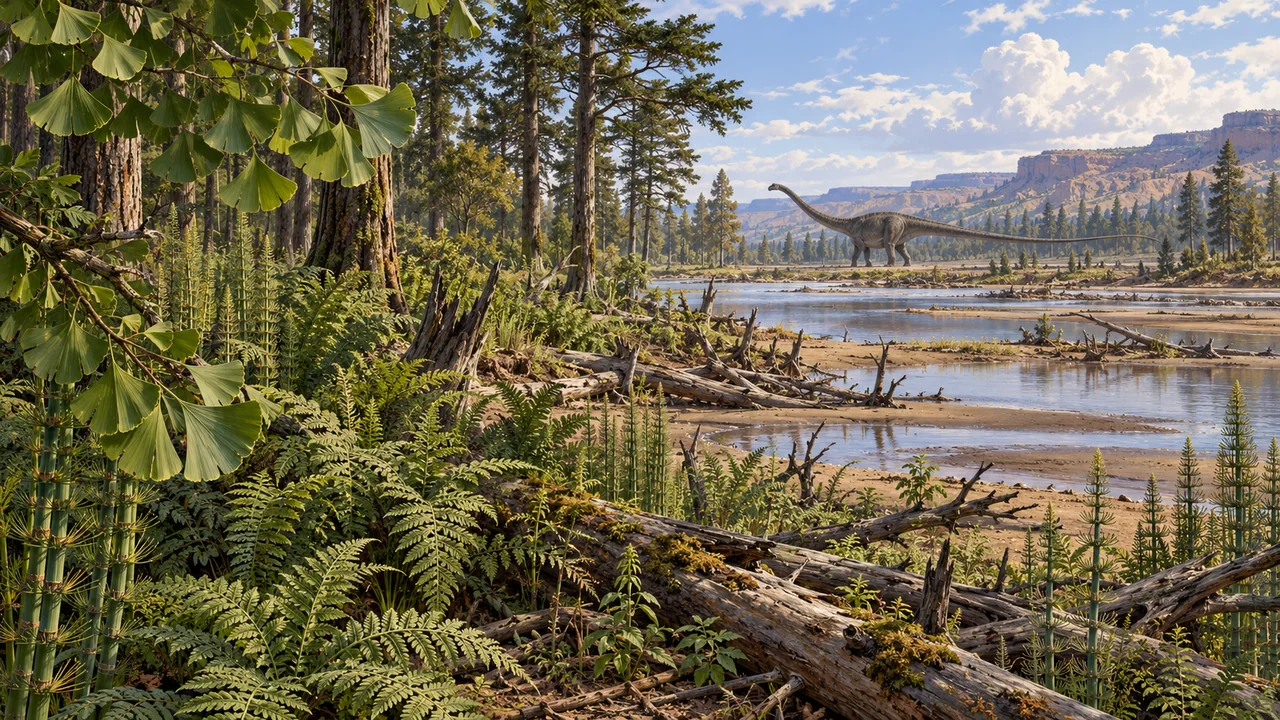
Dinosaurs lived among changing plant communities, including conifers, ferns, cycads, and ginkgo relatives. Flowering plants became increasingly important during the Cretaceous. Some grass fossils also come from before the extinction of non-bird dinosaurs, although modern grassy landscapes should not be placed everywhere in the Mesozoic.
There was no single “dinosaur jungle.” A forest in one region and period could look very different from a floodplain elsewhere millions of years later. Plants help us rebuild those differences.
Reading a forest from fragments
A fossil leaf can preserve its outline and veins. Wood may retain internal structures, while tiny pollen grains and spores can record plants whose larger parts were never found.
The Natural History Museum's palaeobotany collection brings together different forms of plant evidence. Studying them alongside the rock's age and setting helps researchers reconstruct ancient vegetation.
A leaf deposit is still a sample. Water may carry leaves away from the trees that grew them. A pollen grain may travel farther than a heavy branch. Researchers consider those differences before turning a fossil layer into a detailed forest map.
A Jurassic landscape without a lawn
Conifers and ginkgo relatives were prominent parts of many Jurassic landscapes. Ferns and cycads contributed other shapes, from low fronds to stiff crowns of leaves.
The Museum's guide to prehistoric plants explains how living plant groups can help visitors imagine these environments. Their modern relatives offer useful visual comparisons.
That comparison has limits. A present-day garden plant is not automatically the identical species that a dinosaur encountered. Lineages can persist while their individual species change. “Ancient group” and “unchanged living fossil” are different claims.
A believable Jurassic illustration therefore needs more thought than placing a dinosaur in a modern park. The vegetation should match the chosen place and time.
Flowers changed the scenery
Flowering plants, or angiosperms, diversified during the Cretaceous. Their increasing variety added new leaves, fruits, seeds, and relationships with animals to terrestrial ecosystems.
This was a long history, rather than a switch that changed every landscape at the start of the period. Conifers and ferns did not disappear when flowers appeared.
A dinosaur's available food therefore depended on its habitat and geological age. Two plant eaters separated by millions of years could encounter different menus even if their teeth looked broadly similar.
Did dinosaurs ever eat grass?
A 2005 study of Late Cretaceous coprolites from India identified microscopic silica structures, called phytoliths, associated with several grass groups.
The suspected dung producers were titanosaur sauropods. Their identity is inferred, so the result should not be turned into a photograph of a named dinosaur grazing.
The important conclusion is narrower and stronger: grasses were present before non-bird dinosaurs became extinct. It does not follow that Jurassic dinosaurs wandered through modern savannas, or that grass dominated every Cretaceous habitat.
This is a useful example of how an unexpected fossil can correct an oversimplified rule without supporting an equally sweeping replacement.
Plants were more than dinosaur food
Vegetation shaped shelter, shade, riverbanks, and the places where animals could move. A fallen tree or dense patch of plants could affect a small dinosaur differently from a giant sauropod.
Food webs also included insects, fungi, and other organisms associated with vegetation. Reconstructing a dinosaur habitat means considering this wider community rather than drawing only its largest residents.
A fossil plant beside a dinosaur bone does not prove that the dinosaur ate it. Direct dietary evidence, feeding anatomy, and environmental context answer different parts of that question.
Try building a plant evidence scene
Choose one period and one region. Add a few supported plant groups, then mark which details are known and which you invented for the picture.
For example, leaf fossils might support the presence of a group without establishing the height of every tree or the exact color of the forest. Leave those uncertainties visible in your explanation.
Compare our Jurassic guide with the Cretaceous overview, then read about Brachiosaurus. The green background is part of the dinosaur story, and its fossils deserve attention too.
Sources
- Natural History Museum: Prehistoric plants and dinosaur gardens
- Natural History Museum: Palaeobotany collection
- Prasad and colleagues: Dinosaur coprolites and early grasses
Research reviewed: 7 October 2026.