DINOSAUR SCIENCE · 4 MIN READ
How Do We Know What Meat-Eating Dinosaurs Ate?
Investigate bite marks, stomach contents, fossil dung, and tooth anatomy to see how paleontologists reconstruct dinosaur diets.
By Dinosaur Sounds ·
The short answer
Scientists reconstruct carnivorous dinosaur diets from several kinds of evidence: teeth and jaws, feeding marks, swallowed remains, and fossil dung. A bite mark can show that an animal fed on a body, but it does not always reveal whether the feeder killed it.
That distinction separates two different questions. “What did it eat?” concerns diet. “How did it obtain the meal?” concerns behavior. A fossil may answer one much better than the other.
Teeth offer a starting hypothesis
Sharp teeth and cutting edges can suggest feeding on other animals. Tooth shape also affects how an animal grips, slices, or withstands force.
A slender curved tooth and a thick robust tooth are not interchangeable tools. Researchers study the whole feeding system, including jaw proportions, tooth arrangement, wear, and likely muscle forces.
Anatomy establishes what an animal could plausibly do. It usually cannot provide a complete menu by itself. A predator might take several prey types, and its diet could change as it grew.
Reading marks on bones
Grooves, punctures, and scores can preserve contact between teeth and bone. Scientists compare their shape, spacing, and position with possible toothmakers while checking alternatives such as weathering or damage during excavation.
A study of bite traces on Morrison Formation sauropods shows how many details influence interpretation. Where the marks occur can help researchers investigate which parts of a carcass were being used.
Even a convincing feeding trace does not automatically identify the predator species. Several carnivores may have lived in the same environment, and different teeth can produce similar marks.
Hunting and scavenging were compatible
Living predators often scavenge when the opportunity arises. Scavenging animals can also catch living prey. There is no reason to force every dinosaur carnivore into only one of those boxes.
The Natural History Museum's Velociraptor guide discusses both feeding evidence and anatomy consistent with hunting. A swallowed bone can provide dietary information while leaving the circumstances of the meal uncertain.
Finding a predator near a herbivore skeleton is weaker evidence than discovering a tooth embedded in a healed wound. Association alone might result from transport, repeated visits, or other events.
Why healing matters
If bone grew around an injury, the animal survived long enough for a biological response. A healed bite can therefore demonstrate an interaction during life.
An unhealed bite is harder to interpret. It may have been inflicted shortly before death, at death, or afterward. Lack of healing cannot by itself distinguish a successful hunt from scavenging.
The Museum's Tyrannosaurus profile describes tooth marks and swallowed bone among the clues to its feeding. Those observations support a carnivorous lifestyle without supplying a filmed sequence of every encounter.
Stomach contents and fossil dung
Remains inside a body cavity can be especially valuable if their position and preservation support the interpretation as gut contents. Scientists must exclude material that washed into the body after death.
Coprolites, or fossil dung, may contain bone fragments, scales, or other food remains. Identifying the animal that produced them can be difficult, so researchers compare their size, contents, and geological context.
These traces record digestion and meals. A single example still represents a narrow sample, rather than an entire species' permanent eating habits.
A recovered tooth may also have been shed during a separate visit to the carcass. Position and association are useful observations, but the strongest explanation must account for transport and the sequence in which evidence accumulated.
Build a case from several clues
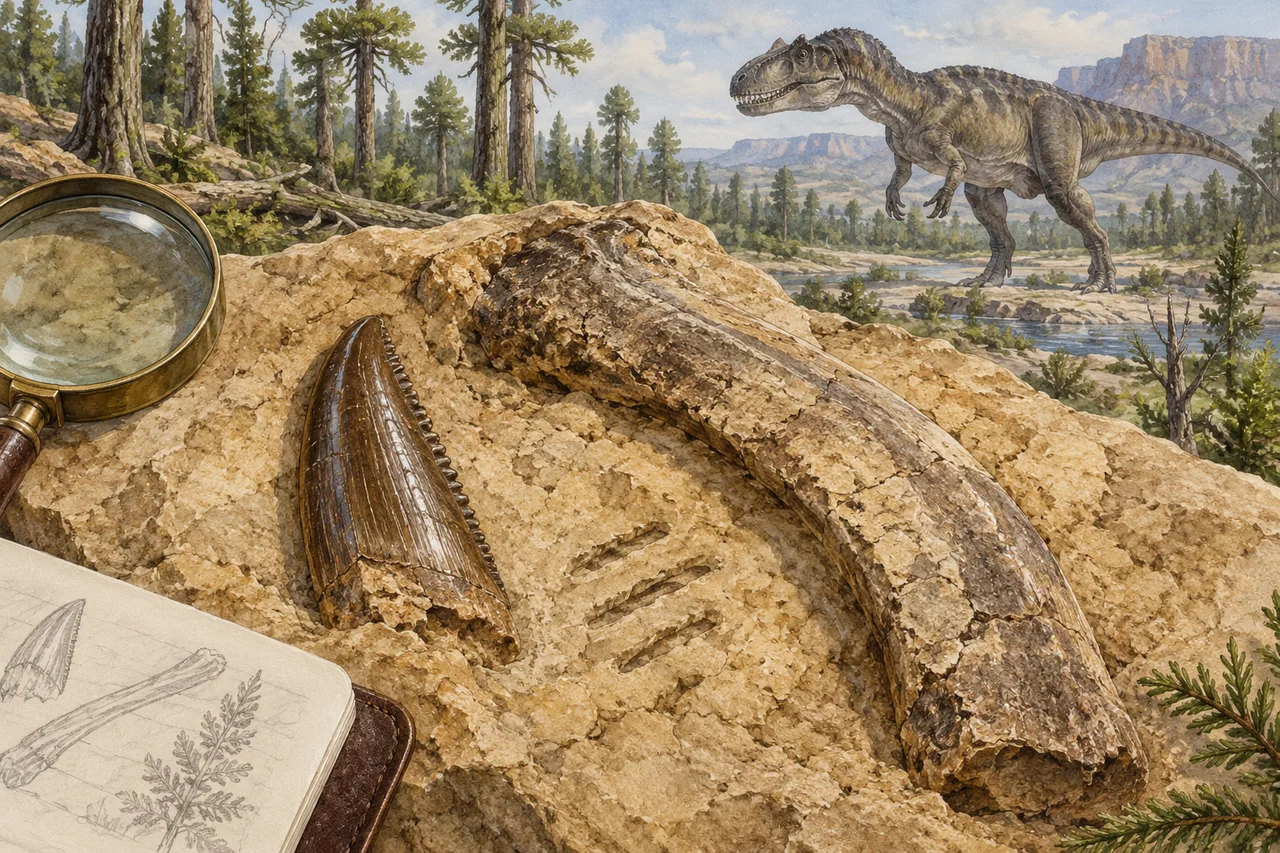
Imagine a bone with grooves beside a broken tooth. Ask whether the tooth fits the marks, whether both belong to the same deposit, and whether the bone shows healing. Each answer changes what can reasonably be concluded.
A good reconstruction combines clues and states the remaining uncertainty. It does not need a dramatic chase scene to be interesting.
Compare our Allosaurus guide with T. rex facts, then browse more articles. The best predator stories explain which parts come from fossils and which parts remain proposals.
Sources
- Bite and tooth marks on Morrison sauropods
- Natural History Museum: Velociraptor facts
- Natural History Museum: Tyrannosaurus
Research reviewed: 7 October 2026.