DINOSAUR SCIENCE · 4 MIN READ
From Dinosaur Discovery to Museum: What Happens to a Fossil?
Follow the careful journey from recording a dinosaur fossil in the field to preparation, cataloging, research, and display.
By Dinosaur Sounds ·
The short answer
A dinosaur fossil's journey to a museum involves much more than digging. Researchers record its location and geology, protect it for transport, prepare it carefully, and give it a permanent catalog record. Some fossils become exhibits; many remain in research collections.
The scientific value includes both the specimen and information about where it came from. Removing a bone without recording its context can lose evidence that no later laboratory work can replace.
Discovery begins with the rocks
Paleontologists search rock formations likely to preserve fossils of the right age. Erosion may expose a fragment that leads to more material beneath the surface.
The Natural History Museum's field guide explains why researchers rarely find a whole skeleton simply waiting on top of the ground. A small exposed piece may be the start of a long investigation.
The team first assesses the site. They need to understand the fossil's condition, how much is present, and what permissions and expertise the work requires.
Record before removing
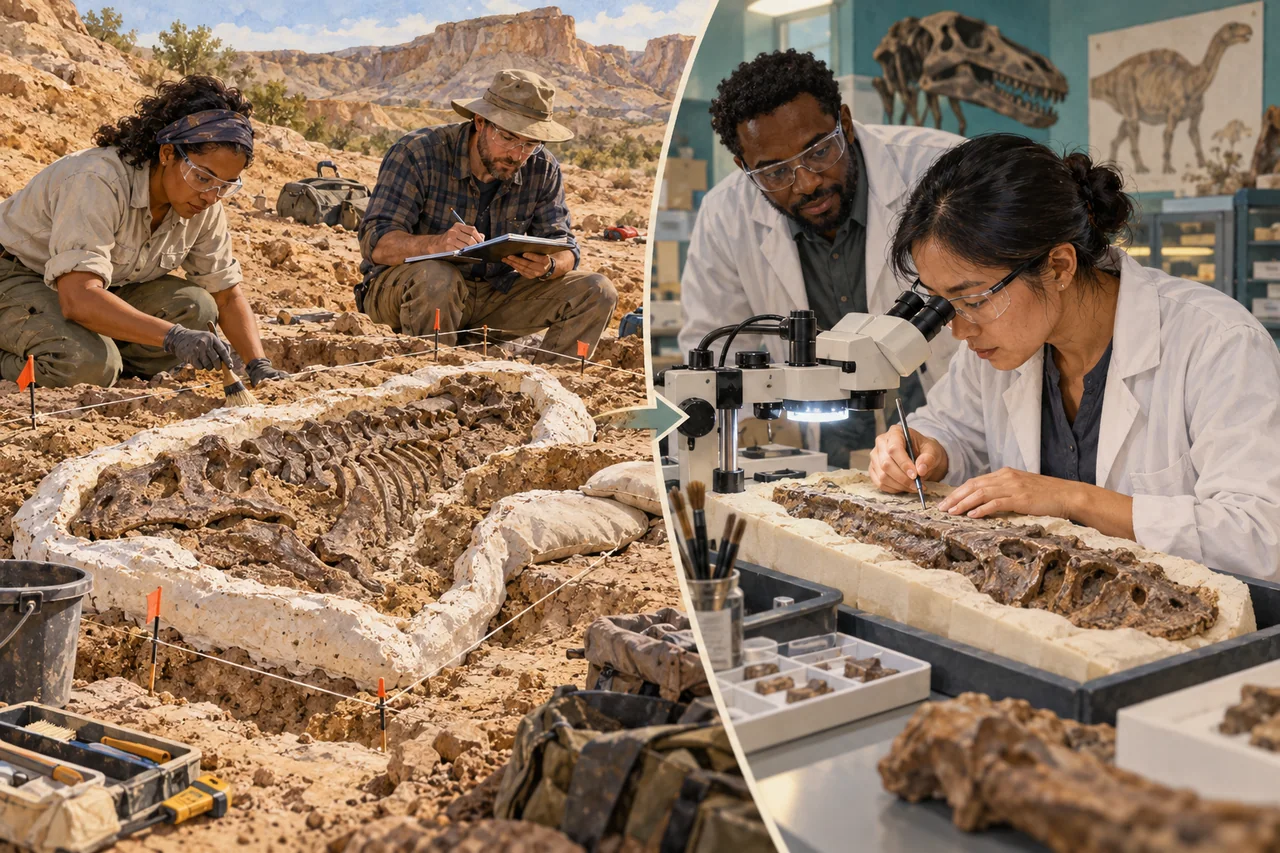
Field notes, maps, photographs, and measurements preserve the arrangement of bones and their relationship to sediment layers.
Are the bones articulated, scattered, or mixed with other animals? Do they lie in a river deposit? Are plant remains or small fossils nearby?
Those questions help distinguish a body buried near where it died from material transported or accumulated over time. The position of an ordinary fragment can therefore be as important as the appearance of a spectacular skull.
Protecting fragile remains
Fossil bone can be brittle, fractured, or softer than the surrounding matrix. Preparators may stabilize exposed surfaces and leave supporting rock in place.
A protective jacket made with suitable separating layers and plaster bandages can surround a block containing the fossil. The American Museum of Natural History's explanation describes this careful field protection.
The jacket is a transport support, rather than a completed museum reconstruction. Large blocks may require planned lifting and logistics. The work is closer to moving a fragile scientific record than collecting a loose souvenir.
Preparation reveals the specimen
In the laboratory, specialists remove matrix using methods appropriate to the fossil. Fine tools, magnification, and sometimes chemical approaches help expose details.
Speed is not the main goal. A rushed preparation can destroy thin structures, surface traces, or evidence needed by future researchers.
Preparators document repairs and materials they add. A filled gap should be distinguishable in the records from original fossil bone, even when a finished exhibit looks visually continuous.
Conservation continues after excavation
Storage and support affect whether a specimen survives for future study. Old jackets and mounts may need inspection, repair, or replacement.
The Museum's jacketed fossil conservation case studies show how historical specimens can require renewed care. The job does not end when the field season finishes.
A specimen can also be rescanned or reexamined as new techniques appear. Good conservation preserves possibilities for questions researchers have not yet imagined.
A catalog number connects the evidence
Museums assign identifiers and maintain records linking specimens to locality, collector, geology, and preparation history. Those records let other scientists locate and reassess the material.
A published claim should ideally point to a specimen that can be studied again. Scientific collections therefore serve a different purpose from an attractive display alone.
Many important fossils are too small, incomplete, or delicate to become exhibition centerpieces. They still contribute to anatomy, environmental reconstruction, and evolutionary research.
What visitors can learn
When you see a skeleton, look for a specimen number, locality, geological age, and explanation of restored parts. Those details connect the exhibit to the evidence behind it.
A replica may communicate a discovery while the original remains safely stored or under study. Both can have legitimate roles when their identity is clear.
Read our paleontology tools article, compare T. rex fossils, and browse more articles. A museum dinosaur represents years of observation, preparation, and stewardship before it ever reaches a gallery.
Sources
- Natural History Museum: How to find dinosaur fossils
- American Museum of Natural History: Dinosaur bones
- American Museum of Natural History: Jacketed fossil conservation
Research reviewed: 7 October 2026.