DINOSAUR SCIENCE · 4 MIN READ
Could Dinosaurs Swim? Tracks, Bodies, and an Ongoing Debate
Explore fossil swim traces and the difference between crossing water, wading, and being an underwater hunting specialist.
By Dinosaur Sounds ·
The short answer
Some dinosaurs almost certainly moved through water, and fossil traces support swimming or partly buoyant movement in certain cases. That does not mean every dinosaur was a strong swimmer. It also does not establish that water-associated dinosaurs routinely chased prey underwater.
Crossing a river, wading along a bank, floating, diving, and hunting while swimming are different behaviors. A good fossil explanation identifies which of those activities its evidence actually supports.
A strange kind of footprint
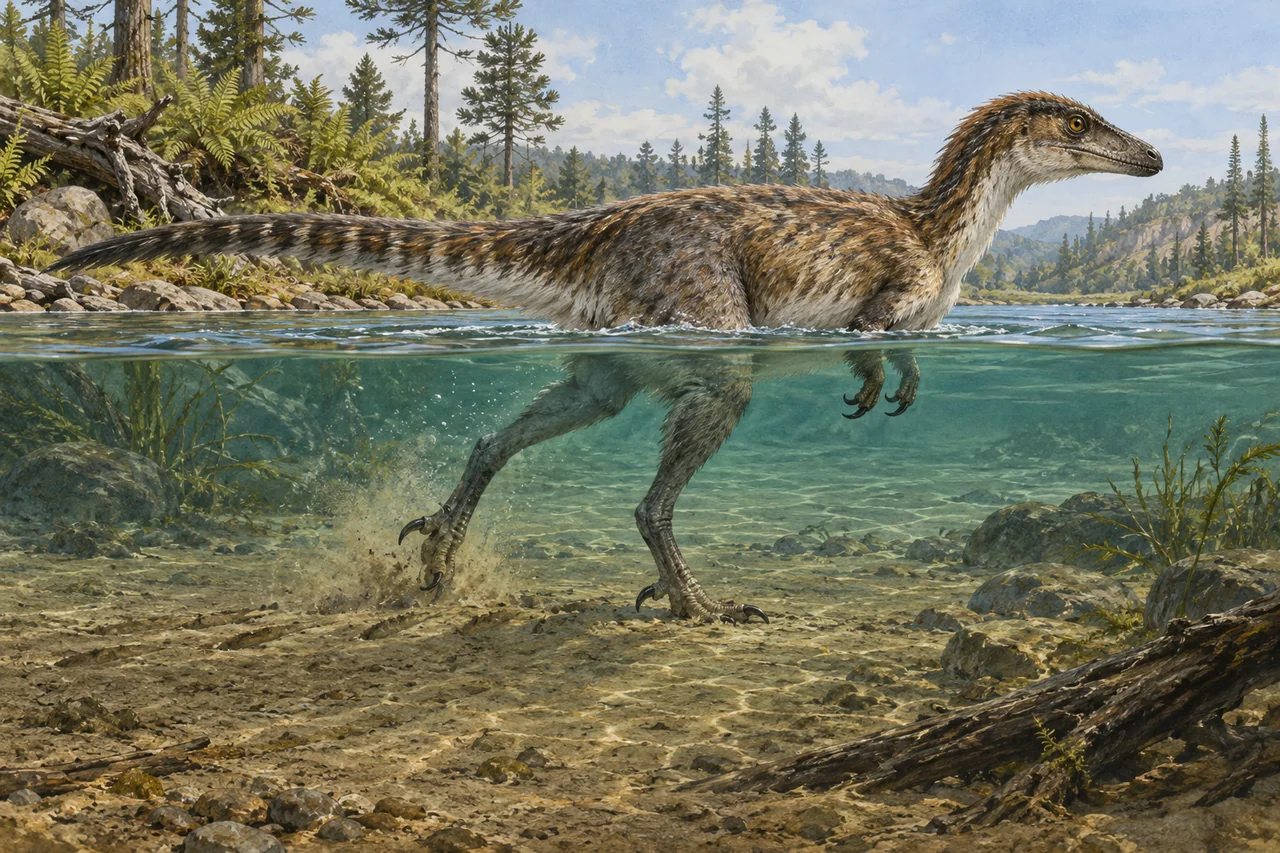
An animal walking on land usually presses much of its foot into the ground. A partly floating animal may touch the bottom only with its claws.
Repeated claw scrapes can therefore suggest movement through water. Researchers examine their arrangement, spacing, sedimentary setting, and relationship to ordinary tracks before identifying them as swim traces.
The Carreras Pampa tracksite study in Bolivia documents many tracks and traces interpreted as swimming activity. The evidence comes from the traces and their context, rather than from a dinosaur skeleton frozen in a swimming pose.
Why a scrape is not enough
A single groove could have several causes. An animal might slip, drag a claw, or disturb sediment in shallow water without fully swimming. Water currents and preservation can also modify the mark.
A convincing interpretation looks for a repeated pattern that fits a plausible movement sequence. It should explain the entire trackway, not just the most unusual print.
The National Park Service's overview of trace fossils places swim traces alongside footprints, burrows, and other behavioral evidence. Each records interaction with a surface, so the surface itself is part of the explanation.
Swimming ability versus an aquatic lifestyle
Many living land animals can cross water without being specialized aquatic hunters. The ability to stay afloat or paddle is a different question from regularly finding food beneath the surface.
For an extinct animal, scientists may investigate buoyancy, limb movement, tail shape, bone density, and feeding anatomy. Those clues must be considered together.
Dense bones might help one animal remain submerged, but density alone cannot reveal its entire lifestyle. A fish-eating diet likewise does not prove underwater pursuit: living animals catch fish from banks, shallows, and the water column.
Why Spinosaurus attracts debate
Spinosaurus had an unusual combination of anatomy and strong associations with watery environments. Researchers have proposed different interpretations of how it moved and caught food.
A University of Chicago explanation of competing analyses shows why bone density and model assumptions matter to the debate. Studies can use related evidence yet reach different conclusions about specialized diving.
It is reasonable to discuss Spinosaurus as closely associated with water while clearly identifying underwater pursuit hunting as disputed. An illustration should not quietly turn one interpretation into a proven observation.
What a model can and cannot show
A digital body can be tested for stability and buoyancy. A physical tail model can be tested for thrust. These are useful experiments with particular assumptions.
The missing tissues, body outline, joint flexibility, and movement chosen for the model influence the result. Demonstrating that a structure produces force does not automatically establish the animal's usual behavior.
Researchers improve models by comparing them with living animals and testing alternative reconstructions. The goal is to narrow the possibilities using evidence.
Water depth can change the same animal's behavior along one route. It might walk, become partly buoyant, and then lose contact with the bottom. A trace surface records only the portions that touched sediment, leaving the fully afloat section invisible.
A better way to ask the question
Instead of asking only “Could this dinosaur swim?”, ask: could it cross a channel, remain stable afloat, push against the bottom, or pursue fast prey underwater?
Those questions invite different tests and can have different answers. A dinosaur might succeed at one and be poorly suited to another.
Explore our Spinosaurus guide, compare Irritator, and read the Mosasaurus article. Keeping behaviors and evolutionary groups distinct makes the ancient waters much easier to understand.
Sources
- Carreras Pampa dinosaur track and swim-trace study
- University of Chicago: Spinosaurus hunting debate
- National Park Service: Trace fossil significance
Research reviewed: 7 October 2026.