DINOSAUR SCIENCE · 4 MIN READ
Dinosaurs in the Arctic: Life Through Long Polar Seasons
Discover Arctic dinosaur babies, ancient forests, and the fossil evidence that some dinosaurs probably stayed in the far north all year.
By Dinosaur Sounds ·
The short answer
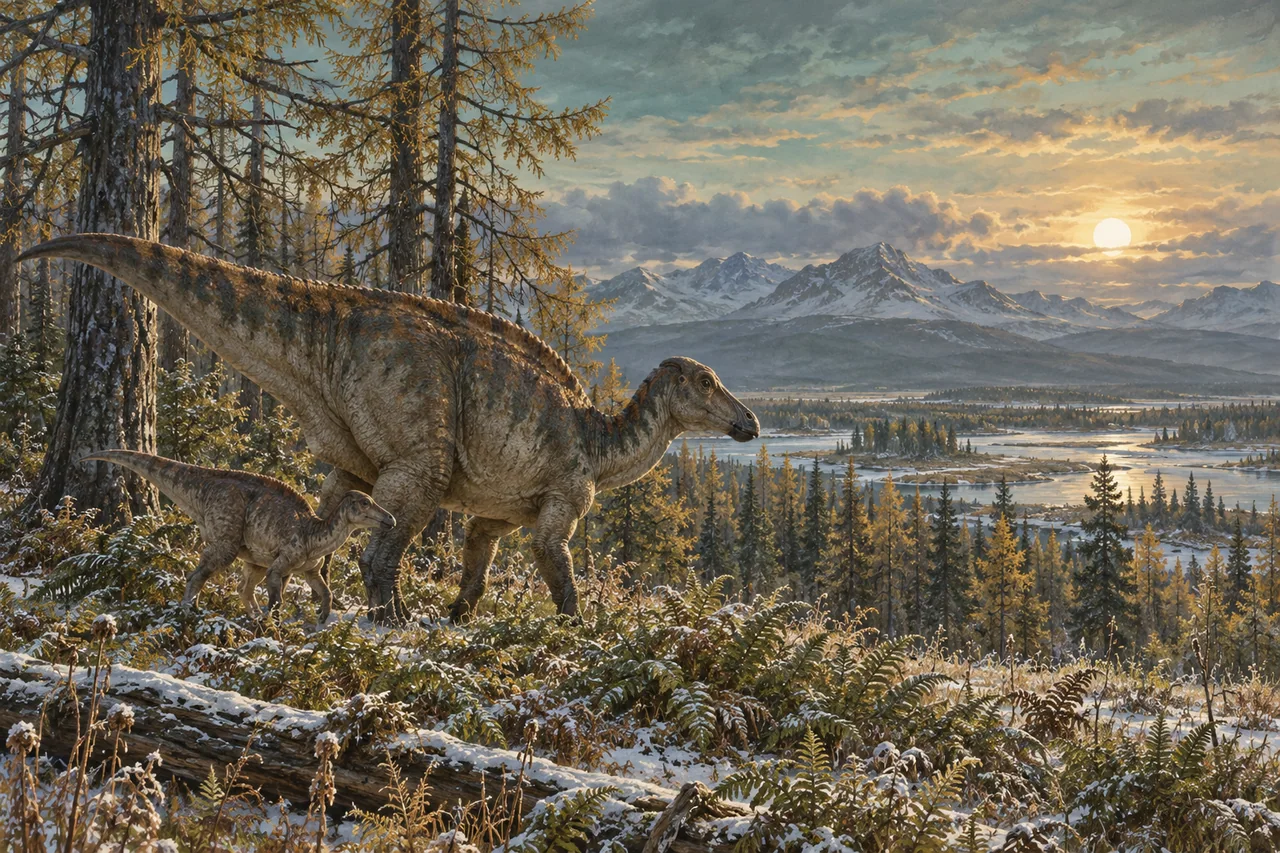
Dinosaurs lived at high northern latitudes, and tiny fossil bones and teeth show that several kinds reproduced in Arctic Alaska. Researchers infer that many probably remained there throughout the year. They faced strong seasonal changes in light, even though the climate differed from today's Arctic.
A polar dinosaur scene should not automatically look like a modern ice sheet. Ancient forests, rivers, and seasonal conditions need to be reconstructed from local evidence.
The importance of very small fossils
A giant skeleton attracts attention, but tiny remains can answer a particularly important question: did dinosaurs breed in the region?
Researchers described bones and teeth from dinosaurs close to hatching or newly hatched in Alaska's Prince Creek Formation. The University of Alaska Fairbanks report explains how these finds support local reproduction across several dinosaur groups.
This evidence goes beyond showing that adults visited the Arctic. Babies document an early life stage in the region, although their exact behavior and survival rates remain difficult to reconstruct.
Why the babies matter for migration
An animal that hatches in a northern summer has limited time to grow before winter. Researchers consider egg incubation and early development when testing whether long-distance migration was realistic.
The inference that many dinosaurs stayed year-round comes from this combination of evidence, rather than from a fossil recording an entire annual journey.
It should not become a claim that no Arctic dinosaur ever migrated. Different species and populations could have used different strategies. The evidence challenges a universal migration explanation.
A warmer Arctic still had seasons
Earth's climate during much of the Cretaceous was warmer than today. Yet a high-latitude location still experienced extreme seasonal changes in day length.
Temperature and daylight are different environmental factors. Mild conditions do not remove long winter darkness, and summer daylight does not guarantee abundant food throughout the year.
Researchers use fossil plants, sediments, and other evidence to investigate local climates. A dinosaur found far north is evidence of its presence, but not a thermometer giving the exact temperature on the day it died.
Denali reveals another northern landscape
Denali's Late Cretaceous record includes abundant footprints and plant fossils. It provides a window into a northern environment with rivers, lakes, marshes, and forested areas.
The National Park Service's climate reconstruction describes a landscape much milder than modern Denali. Local plant communities varied with drainage and soil conditions.
Denali and the more northerly Prince Creek sites should not be treated as one identical locality. Their evidence can be compared, but geography and geology still matter.
How might dinosaurs have coped?
Proposed strategies include insulation in feathered species, flexible diets, and physiological adaptations. Different dinosaur groups probably faced different challenges.
These are research questions. Fossils do not establish that every northern dinosaur hibernated, grew a winter coat, or behaved like a modern reindeer.
The Park Service's overview of Denali paleoecology demonstrates the value of combining tracks, plants, and traces of many organisms. Understanding an ecosystem requires more than placing a dinosaur against a snowy background.
Food presents a particularly useful seasonal question. A plant-eating dinosaur needed available vegetation, while a predator depended on other organisms in the food web. A reconstruction must therefore explain more than how the animal stayed warm. It should ask which resources persisted, how their availability changed, and which parts of that proposed annual cycle have fossil support.
Reconstructing a year, rather than a postcard
For a useful activity, draw the same ancient forest in summer and winter. Keep the geography and dinosaur anatomy consistent, then identify which seasonal details are supported and which are imagined.
You might confidently change the amount of daylight while treating exact snow depth or dinosaur grouping as uncertain. That distinction makes the activity both creative and scientifically useful.
Read our Cretaceous overview, compare different bodies in the dinosaur profiles, and explore where dinosaur fossils have been found. Arctic discoveries expand the dinosaur world far beyond the familiar tropical swamp.
Sources
- University of Alaska Fairbanks: Arctic dinosaur nursery
- National Park Service: Denali's Cretaceous climate
- National Park Service: Paleoecology of Denali dinosaurs
Research reviewed: 7 October 2026.