Fictional adventure · Curiosity
Tansy and the Missing River
A young Triceratops follows a trail of wet stones and discovers that asking a careful question can change an entire herd’s journey.
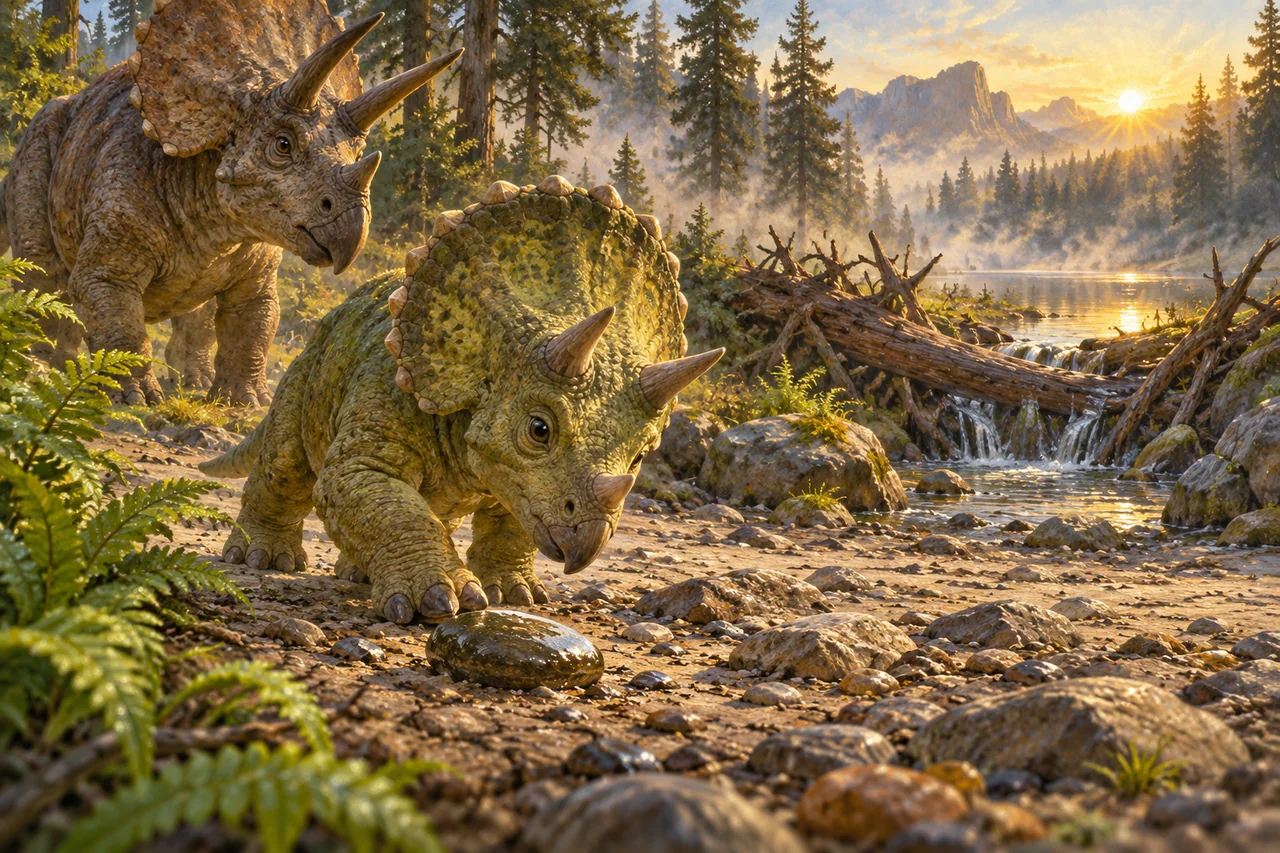
Story time: The characters, dialogue and events below are fiction. A separate factual note follows the adventure.
The river was missing. Yesterday it had curled around the fern beds with a busy, brown whisper. This morning only a ribbon of damp mud remained. Tansy stood where the water should have been and stared at a fish-shaped stone. Behind her, the Triceratops herd shuffled toward the eastern hills. Grandmother Bracken knew a distant watering place, but reaching it would take the whole hot day. Everyone was thirsty already.
“Rivers don’t simply leave,” Tansy said. Her older cousin Flint snorted. “This one has.” He hurried after the others, swinging his broad frill. Tansy almost followed. Then she noticed a smooth pebble halfway up the bank. Its top was dry, but water gleamed underneath. She nudged it gently. A tiny trickle appeared, ran between her toes, and vanished into the sand. Somewhere nearby, water was still moving.
Tansy called to her mother, Willow. “May we look upstream before we go?” Willow studied the herd, now a slow line among the trees. “As far as the bend. We stay together.” Tansy wanted to sprint, but her mother made her stop at the cracked edges of the channel. Those patches could crumble. They walked along firm ground instead, and Tansy began noticing things she had missed: fresh splinters, flattened reeds, a branch snagged high in a bush.
Around the bend, an enormous fallen tree lay across the narrow channel. More branches had piled against it during the night. Behind the tangle, water spread into a broad, shallow pool. Tansy’s heart jumped. “We found it! We can push the tree away.” She lowered her little horns. Willow stepped in front of her. The trunk was wedged between rocks, and the water pressed hard against its far side. Moving it suddenly could send a dangerous rush downstream.
Tansy’s excitement shrank to a disappointed lump. Finding a problem had seemed so close to fixing it. She sat in the shade while Willow called the herd back with a deep, carrying sound. The older dinosaurs gathered, thirsty and impatient. Flint frowned at the tangled branches. “So the river is here. That doesn’t help us drink over there.” Tansy looked again at the pool. It reached almost to a low saddle in the bank, beside a broad stretch of solid stone.
“What if we don’t move the tree?” she asked. “What if we let a little water go around?” Grandmother Bracken inspected the saddle. On its far side, an old channel curved back toward the fern beds. The herd had used that channel before Tansy hatched. “That is a question worth checking,” Bracken said. She tested the ground, then chose a route that sloped gently and kept everyone above the pool. Tansy watched from a safe patch of shade.
Working slowly, the adults scraped loose mud from the shallow saddle with their feet. Willow pushed a small fallen branch aside. Bracken stopped them twice to examine the new edge. At last a thin stream slipped through. It drew a silver line across the stone, paused in a hollow, and spilled into the old channel. Nobody cheered at first. They listened. The trickle became a murmur, and the murmur kept going.
Flint followed its progress downstream and returned with wet feet. “It’s reached the ferns!” The herd drank where the new stream spread into a quiet pool. They left the main tangle alone and chose a sheltered place nearby to rest. The journey to the eastern hills could wait. Tansy took three long drinks, then searched for her fish-shaped stone. It had disappeared beneath the returning water, which seemed a perfectly good place for it.
That evening Flint settled beside her. “You found the river,” he said. Tansy considered the fallen tree, the wet pebble, and all the careful work. “I found a reason to look,” she replied. Bracken smiled from the fern bed. Before falling asleep, Tansy listened to the water finding its new way home. She still had questions. Where would tomorrow’s mud settle? Would the old channel grow wider? For once, nobody told her to stop asking.


