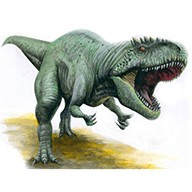
Irritator, the crocodile snouted hunter
Discovery, Naming, and Scientific Frustration
The fossil remains of Irritator were discovered in the Romualdo Formation of northeastern Brazil, a region famous for preserving fossils in remarkable detail. The skull was initially damaged and illegally modified by fossil dealers, who added plaster to make it appear more complete. This alteration caused significant confusion for scientists attempting to study it.
When palaeontologists finally examined the fossil properly, they realized parts of the snout had been incorrectly reconstructed. After careful preparation, the true anatomy was revealed, leading to the dinosaur’s name: Irritator challengeri. The genus name reflects the irritation felt by researchers, while the species name honors Professor Challenger, a fictional character from Arthur Conan Doyle’s The Lost World.
Despite the rocky start, the corrected skull turned out to be one of the most informative spinosaurid fossils ever found.
Skull Structure and Feeding Adaptations
Irritator’s skull was long, narrow, and low, resembling that of a modern crocodile. Its jaws were filled with straight, conical teeth that lacked serrations. This tooth shape is ideal for gripping slippery prey such as fish, rather than slicing through flesh.
At the tip of the snout, the jaws slightly expanded, forming a subtle “rosette” of teeth. This feature is also seen in other spinosaurids and helps trap prey once it is caught. The position of the nostrils, set farther back on the skull, suggests Irritator could breathe while most of its snout was submerged in water.
Together, these traits strongly indicate a specialised feeding strategy focused on aquatic animals.
Size, Body Shape, and Lifestyle
Although no body fossils have been found, Irritator is estimated to have measured around 6–8 metres in length. It was likely lighter and more slender than massive theropods such as Allosaurus, trading brute force for speed and precision.
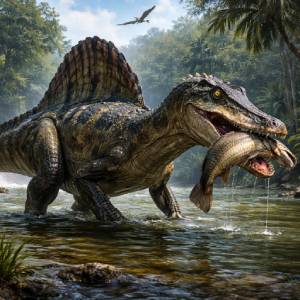
Based on close relatives, Irritator probably had strong forelimbs with large claws, useful for hooking fish or stabilising prey. Its body proportions suggest it spent a significant amount of time near rivers, lagoons, and coastal environments, hunting along shorelines rather than deep inland forests.
This semi-aquatic lifestyle made Irritator part of a unique group of dinosaurs that blurred the line between land and water predators.
The Early Cretaceous World of Brazil
During the Early Cretaceous, northeastern Brazil was a warm, tropical region dominated by rivers, floodplains, and shallow seas. The Romualdo Formation preserves fish, turtles, pterosaurs, and marine reptiles, painting a vivid picture of a rich aquatic ecosystem.
Irritator likely occupied the role of a top shoreline predator, feeding primarily on fish and small aquatic animals. By specialising in this niche, it avoided direct competition with larger land-based carnivores, allowing multiple predator species to coexist in the same environment.
Irritator’s Role in Spinosaurid Evolution
Irritator is crucial for understanding spinosaurid diversity. Its skull differs from both Spinosaurus and Baryonyx, showing that spinosaurids were not a single, uniform type of dinosaur but a varied group with different adaptations.
The fossil helped confirm that spinosaurids evolved highly specialised feeding strategies early in their history. Rather than being transitional or experimental forms, dinosaurs like Irritator were successful, well-adapted predators in their own right.
What Remains Unknown
Because Irritator is known only from a skull, many questions remain unanswered. Scientists do not yet know the exact shape of its sail (if it had one), how well it swam, or how much time it spent in the water versus on land.
Future discoveries from Brazil could dramatically expand what we know about this dinosaur. Even so, Irritator already plays an outsized role in palaeontology, proving that even a single fossil can reshape our understanding of dinosaur evolution.
Why Irritator Matters
Irritator demonstrates that dinosaurs were far more ecologically diverse than once believed. It challenges the traditional image of theropods as purely land-based hunters and highlights the evolutionary experimentation that occurred during the Age of Dinosaurs.
As research continues, Irritator remains a key piece of evidence showing how dinosaurs adapted to rivers, coastlines, and aquatic food sources long before mammals ever attempted similar lifestyles.
Loading a Random Dinosaur...
Enjoy our free mobile app!